A Comprehensive Guide to Tankless vs Traditional Water Heaters
JMAC Plumbing and Air Conditioning
Compare water heater options tankless and traditional to find the best system for your Las Vegas home.
A Comprehensive Guide to Tankless vs Traditional Water Heaters
Are Tankless or Traditional Water Heaters the Better Choice for Your Home?
When comparing water heater options tankless and traditional, here is what you need to know at a glance:
| Feature | Traditional Tank | Tankless (On-Demand) |
|---|---|---|
| How it works | Heats and stores 30-80 gallons | Heats water only when needed |
| Energy efficiency | Standard; loses heat while idle | 24-34% more efficient for most homes |
| Lifespan | 8-12 years | 20+ years |
| Hot water supply | Limited to tank size | Continuous |
| Installation complexity | Simple, lower cost | More complex, higher upfront cost |
| Best for | Budget-conscious buyers, large families with high simultaneous demand | Homeowners focused on long-term savings and space |
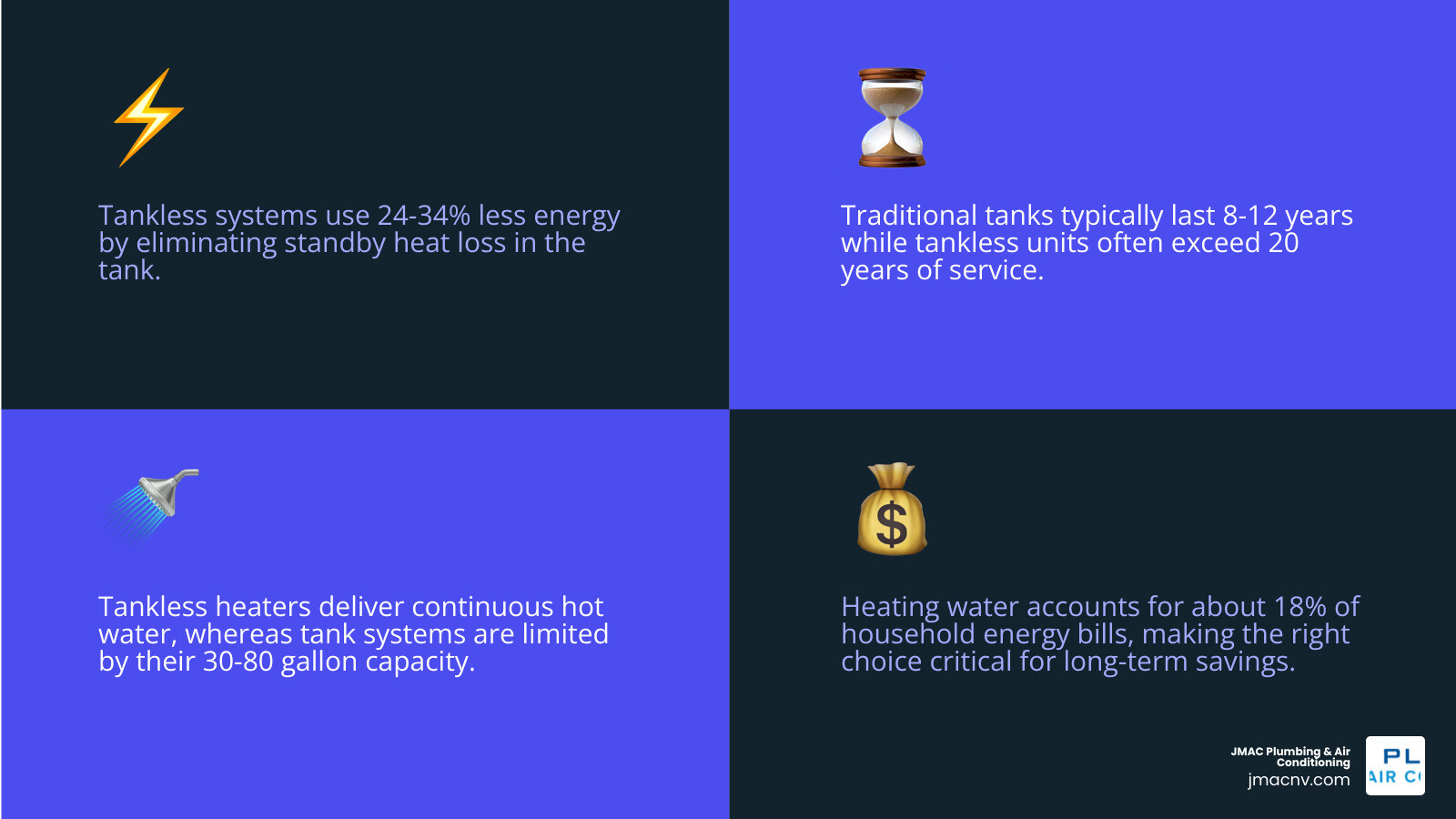
Heating water accounts for roughly 18% of a household's energy bill — and the type of system you choose will affect that number every single month for the next decade or more. Most homeowners only think about replacing their water heater when something goes wrong — a cold shower, a puddle on the floor, or a unit that simply stops working. That rushed decision can lead to choosing the wrong system for your home's actual needs.
Understanding the real differences between tankless and traditional storage tank water heaters — how they work, what they cost to run, how long they last, and which fits your household — puts you in a much stronger position before something breaks.
My name is Stephen Schmid, and through years of helping homeowners navigate plumbing decisions, I've seen how the right knowledge about water heater options tankless and traditional can save families both money and frustration. In the sections ahead, we'll walk through everything you need to make a confident, informed decision.
Comparing Water Heater Options Tankless and Traditional
When you are looking for a new Water Heater, you will quickly find that the market is divided into two primary camps: traditional storage tank systems and modern Tankless Water Heater units.
The core debate centers around how hot water is delivered to your taps. Traditional systems rely on keeping a massive reservoir of water hot and ready at all times, while tankless systems heat water dynamically on-demand.
Choosing between these options is not a one-size-fits-all scenario. Factors like household size, daily hot water usage patterns, local water chemistry, and your long-term plans for your property all play a major role. For a deep dive into local considerations, you can check out our guide on Choosing the Best Water Heater for Your Las Vegas Home.
How Traditional Storage Tank Systems Work
Traditional storage tank water heaters are the familiar metal cylinders found in many utility closets, garages, or basements. These units act like a giant thermos. They constantly hold a set volume of water—usually between 30 and 80 gallons—and keep it heated to a programmed temperature (typically 120°F) around the clock.
Inside the tank, heating elements (either electric resistance coils or a gas burner located underneath) cycle on and off to maintain that temperature. When you turn on a hot water tap, preheated water is drawn from the top of the tank and sent through your pipes. Simultaneously, cold water enters the bottom of the tank to replenish the supply, triggering the heating elements to cycle back on.
The main drawback of this design is standby heat loss. Because the tank is constantly keeping dozens of gallons of water hot, heat continuously escapes through the tank walls, requiring the system to burn energy even when you are asleep or away at work. If you notice your tank struggling to maintain temperatures, it might be a sign of aging. Learn more about these warning signs in our article on Knowing When It's Time to Replace Your Water Heater.
How Tankless On-Demand Systems Work
Tankless water heaters do away with the storage tank entirely. Instead of keeping a large volume of water hot all day, they remain idle until you turn on a hot water tap somewhere in your home.
When a faucet is opened, cold water flows into the unit. A flow sensor detects this movement and immediately activates the heating source—either a high-powered electric element or a gas burner. The water circulates through a technical component called a heat exchanger, which instantly transfers intense heat to the flowing water.
By the time the water exits the unit, it has reached your desired temperature. This process provides a continuous supply of hot water without standby energy losses. If you are considering making the switch, professional installation is key to ensuring the system is properly integrated into your home's infrastructure. You can explore our services for Tankless Water Heater Installation Replacement to see how we handle this transition.
Key Differences in Performance and Efficiency
When comparing performance, we look closely at how efficiently a system converts energy into hot water. This efficiency is measured by the Uniform Energy Factor (UEF). A higher UEF rating means the system is more efficient, converting a higher percentage of its fuel source directly into hot water.
| Performance Metric | Traditional Storage Tank | Tankless On-Demand |
|---|---|---|
| Hot Water Delivery | Instantaneous until tank empties | 30-60 second delay, but endless supply |
| Standby Energy Loss | Yes (constantly reheating idle water) | No (only heats water on-demand) |
| Space Requirements | Large footprint (requires dedicated floor space) | Compact, wall-mounted design |
| Recovery Rate | Slow (can take 30-60 minutes to reheat tank) | Instantaneous (no recovery time needed) |
| Susceptibility to Hard Water | High (sediment settles at the bottom) | Very High (scale coats the heat exchanger) |
If you are planning an upgrade, understanding these performance baselines will help you select the right fit. We offer professional guidance and seamless setups through our Water Heater Installation Replacement service.
Flow Rates and Capacity Limits
A common misconception about tankless water heaters is that "endless hot water" means "unlimited hot water." While a tankless unit will never run out of hot water, it does have a strict limit on how much hot water it can produce at any single moment. This is measured in gallons per minute (GPM).
Most residential tankless units deliver between 2 and 5 GPM. To put this in perspective:
- A standard showerhead uses about 2.0 to 2.5 GPM.
- A washing machine uses around 2.0 GPM.
- A dishwasher uses about 1.5 GPM.
If two people are showering simultaneously while the dishwasher is running, your total peak demand could easily reach 6.0 GPM or more. If this exceeds your tankless unit's capacity, the system will struggle to heat the water to the target temperature, resulting in lukewarm showers.
Traditional tank systems, on the other hand, do not have GPM flow limits in the same way. As long as there is hot water stored in the tank, you can run multiple fixtures at full pressure with perfectly hot water—until the reservoir runs dry.
Energy Efficiency and Standby Loss
Standby loss is the primary driver of energy waste in traditional systems. Because water is kept hot 24/7, you are paying to heat water that you may not use for hours.
According to the U.S. Department of Energy, for homes that use 41 gallons or less of hot water daily, tankless water heaters can be 24% to 34% more energy efficient than conventional storage tank models. Even in busy households that consume around 86 gallons of hot water per day, demand heaters remain 8% to 14% more energy efficient.
In recent years, heat pump hybrid models have also emerged as a highly efficient option for storage tanks. These systems pull heat from the surrounding air to heat the water, making them two to four times more energy-efficient than standard electric resistance tanks. As we navigate stricter energy standards, choosing a high-efficiency model is one of the smartest ways to keep your monthly utility bills in check.
Installation and Maintenance Requirements
Upgrading or replacing a water heater involves more than just swapping out the unit. The physical space, venting pathways, and utility lines in your home dictate which system can be safely installed. To ensure your system meets all local building codes and operates safely, we recommend scheduling a professional Water Heater Inspection Testing before making a final decision.
Installation Requirements for Water Heater Options Tankless and Traditional
Traditional tank water heaters are relatively straightforward to replace, especially if you are swapping an old tank for a new one of the same fuel type. They require basic plumbing connections and a standard vent.
Tankless installations, however, are significantly more complex:
- Venting: Gas-fired tankless units produce highly acidic condensation and hot exhaust. They require specialized Category III or IV stainless steel or PVC venting to safely channel gases outside, which often means cutting new vent paths through exterior walls.
- Gas Line Upsizing: A tankless unit requires a massive burst of energy to heat cold water instantly. While a standard tank might need 40,000 BTUs, a tankless unit can require up to 200,000 BTUs. This often means your existing gas line must be upsized from a half-inch pipe to a three-quarter-inch pipe.
- Electrical Upgrades: Electric tankless models draw an immense amount of power. Installing one often requires a dedicated 240-volt circuit and may even necessitate an upgrade to your home's main electrical panel.
For a detailed look at whether your home's infrastructure is ready for an on-demand system, our Tankless Water Heater Inspection Testing service can provide the answers you need.
Maintenance Needs and Hard Water Challenges
No matter which type of water heater you choose, regular maintenance is essential to preserve its efficiency and prevent premature failure. This is especially true in Clark County, NV, where the municipal water supply contains high levels of calcium and magnesium.
- Traditional Tanks: Over time, dissolved minerals settle to the bottom of the tank, forming a thick layer of sediment. This sediment acts as an insulator, forcing the burner or heating elements to work harder to heat the water, which can cause the tank bottom to overheat and eventually crack. Regular Water Heater Maintenance Tune Up services, including an annual tank flush, are vital to keep sediment from building up.
- Tankless Units: Hard water is particularly damaging to tankless systems. As water is heated instantly inside the narrow copper tubes of the heat exchanger, minerals rapidly bake onto the metal surfaces. This scale buildup restricts water flow and insulates the heating elements, which can cause the heat exchanger to overheat and fail. To protect your investment, an annual descaling flush using a specialized solution is highly recommended. You can learn more about how we protect these advanced systems through our Tankless Water Heater Maintenance Tune Up services.
Lifespan and Long-Term Value
Investing in a new water heating system is a long-term commitment. Understanding how wear and tear affects each system can help you avoid unexpected failures and water damage down the road. If you ever find yourself facing a sudden puddle in your utility closet, read our guide on Dealing with a Leaking Water Heater or watch our helpful video on What Should I Do If My Water Heater Is Leaking for immediate steps to protect your property.
Lifespan and Longevity of Water Heater Options Tankless and Traditional
When it comes to durability, tankless water heaters have a clear advantage. Because they do not store water, they are far less susceptible to the internal rust and corrosion that eventually destroys storage tanks.
- Traditional Tanks: Typically have a service life of 8 to 12 years. Once the inner steel lining of a tank corrodes, the unit cannot be repaired and must be replaced. If your tank is nearing the end of its lifespan, our Water Heater Repair Service team can evaluate its condition and help you plan a replacement.
- Tankless Units: Boast an average lifespan of 20 years or more. Furthermore, tankless systems are highly modular, meaning individual components like the heat exchanger, flow sensor, or control board can be replaced independently, extending the unit's overall life. If a component does fail, our Tankless Water Heater Repair Service can swap out the broken part to get your hot water running again without requiring a whole new system.
Choosing the Best System for Your Household
Deciding between water heater options tankless and traditional comes down to analyzing your household's daily routines and long-term plans. To find the perfect match, consider these key decision factors:
- Household Size and Peak Demand: Do you have a large family where multiple showers, the washing machine, and the dishwasher run at the same time? A traditional tank or a multi-unit tankless system may be necessary to handle that concurrent load.
- Space Constraints: If you live in a home with limited closet space, a wall-mounted tankless unit can free up valuable square footage.
- Length of Home Ownership: Because tankless systems have a higher initial installation cost, it takes several years of lower utility bills to offset the upfront investment. If you plan to stay in your home for 10 to 20 years, tankless is an excellent choice. If you plan to move in a few years, a traditional tank may be more economical.
- Water Quality: If your home is equipped with a water softener, a tankless unit will thrive. If you have extremely hard water and do not want to commit to annual descaling maintenance, a traditional tank may be easier to manage.
Frequently Asked Questions about Water Heaters
How long does a water heater last in Las Vegas?
In Las Vegas and the surrounding Southern Nevada communities, a standard traditional tank water heater typically lasts between 8 and 12 years. However, because our local water supply is heavily mineralized, untreated hard water can shorten that lifespan. Tankless models can last 20 years or more, but they require regular, proactive maintenance to prevent scale from damaging the heat exchanger.
Can I switch from a traditional tank to a tankless system?
Yes, you can absolutely convert your home from a traditional tank to a tankless system. This is a very popular upgrade for homeowners looking to reclaim floor space and enjoy continuous hot water. However, it is not a direct swap. The installation process requires retrofitting your plumbing, upgrading your venting to Category IV standards, and potentially upsizing your gas line or electrical service panel to handle the high energy demand of on-demand heating.
How does hard water affect tankless and traditional water heaters?
Hard water is the leading cause of premature water heater failure in our region. In traditional tanks, minerals settle at the bottom, forming an insulating barrier that causes the tank to overheat and fail. In tankless systems, calcium scale bakes directly onto the heat exchanger. This restricts water flow, reduces heating efficiency, and can cause the system to overheat and shut down. Installing a water softener or committing to an annual descaling protocol is the best way to protect both types of systems.
Conclusion
Choosing between water heater options tankless and traditional is a significant decision that impacts your home's comfort, efficiency, and utility bills for years to come. Traditional tanks remain a reliable and budget-friendly option for simple replacements, while modern tankless systems offer space savings, endless hot water, and superior energy efficiency for homeowners looking toward the future.
At JMAC Plumbing & Air Conditioning, we have spent over 30 years helping homeowners across Las Vegas, Henderson, North Las Vegas, and the greater Clark County region find the perfect solutions for their homes. Whether you need a quick repair, a routine maintenance tune-up, or a complete system replacement, our family-owned team is here to provide fast, honest, and professional service.
If you are ready to explore your options or need immediate assistance, contact us today to schedule a consultation or learn more about our comprehensive Water Heater services.
Need Help?
Contact us today to discuss your needs. Our team is ready to help.
About the Author
JMAC Plumbing and Air Conditioning
More Articles
View All PostsRelated Articles


Ready to Get Started?
Whether you need a repair, maintenance, or a new installation, our expert team is here to help.