Beginner's Guide to Tankless vs Tank Water Heater Comparison
JMAC Plumbing and Air Conditioning
Compare tankless vs tank water heater comparison for desert homes to find the best system for your Las Vegas household.
Beginner's Guide to Tankless vs Tank Water Heater Comparison
Why the Tankless vs Tank Water Heater Comparison Matters for Desert Homes
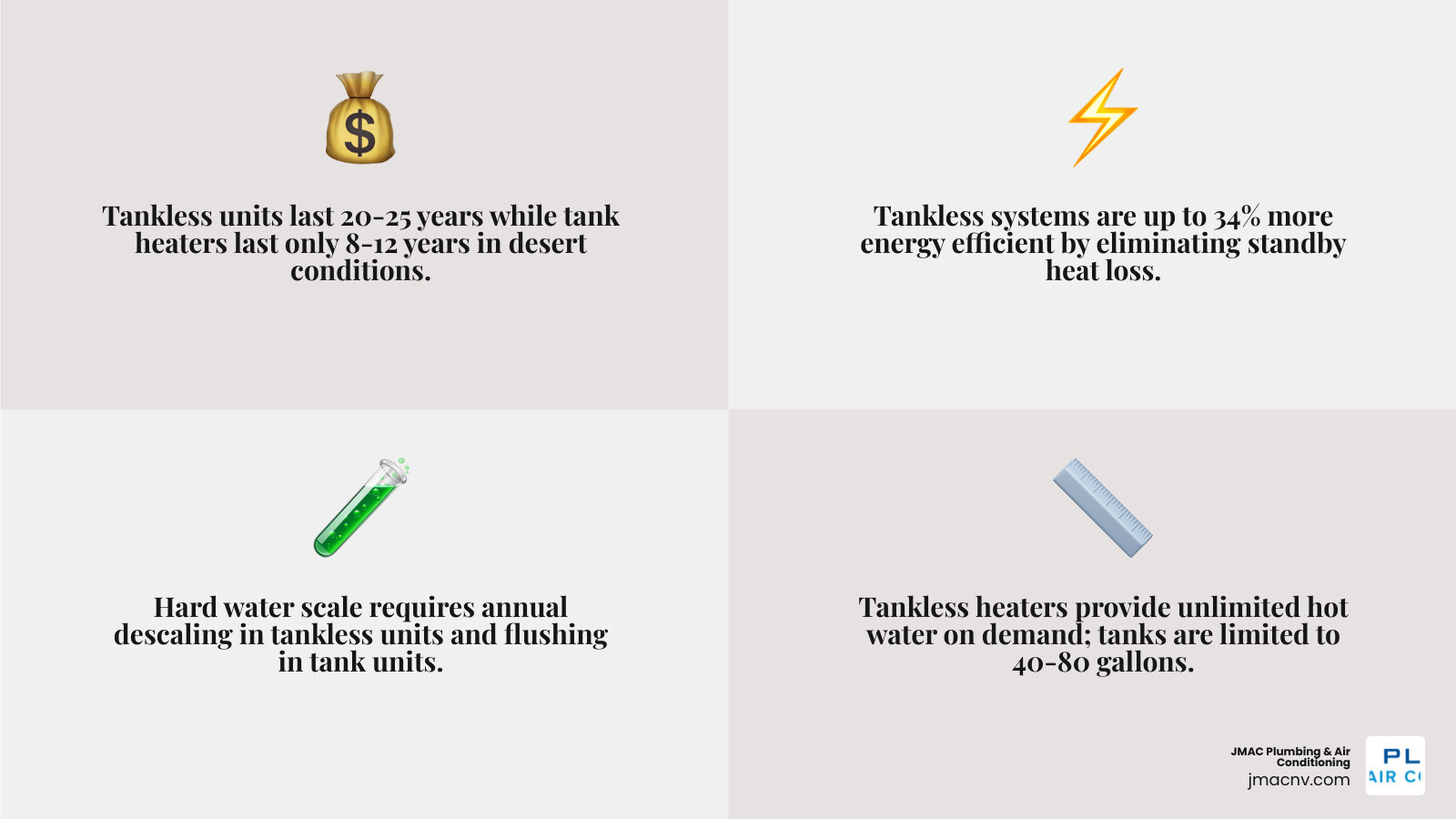
Making the right tankless vs tank water heater comparison for desert homes could save you thousands of dollars over the life of your system — and spare you the frustration of cold showers, skyrocketing energy bills, and premature equipment failure. Here's a quick summary to help you decide:
| Factor | Tankless Water Heater | Tank Water Heater |
|---|---|---|
| Lifespan | 20-25 years | 8-12 years (desert conditions) |
| Energy Efficiency | Up to 34% more efficient | Loses energy 24/7 via standby heat loss |
| Hard Water Impact | Scale clogs heat exchanger; annual descaling required | Sediment settles at bottom; annual flushing needed |
| Hot Water Supply | Unlimited, on demand | Limited to tank capacity (40-80 gallons) |
| Space | Wall-mounted, compact | Large floor footprint required |
| Upfront Cost | Higher | Lower |
| Best For | Long-term owners, 3+ person households | Budget-conscious buyers, low-demand homes |
Bottom line: For most Las Vegas and Southern Nevada homeowners planning to stay in their home for several years, a tankless system delivers better long-term value — but only when properly sized, installed, and maintained for desert conditions like hard water and extreme heat.
Desert homes face a set of challenges that most general water heater guides simply skip over. Las Vegas groundwater is among the hardest in the country, with mineral concentrations that accelerate wear on both types of systems. At the same time, water heating accounts for roughly 18% of the average home energy bill — making the choice between these two technologies one of the most impactful decisions you can make for your home's efficiency and comfort.
I'm Stephen Schmid, and my background in customer service and home comfort systems has given me a front-row seat to how desert climates shape the tankless vs tank water heater comparison for desert homes in ways that matter to real Las Vegas families. In the sections below, I'll walk you through everything you need to make a confident, informed decision for your Southern Nevada home.
The Ultimate Tankless vs Tank Water Heater Comparison for Desert Homes

When we compare standard storage tank water heaters with modern tankless models in Southern Nevada, we are looking at two entirely different ways of keeping your household comfortable.
Traditional storage tanks are simple. They operate like a giant kettle, holding 40 to 80 gallons of water and keeping it hot 24 hours a day, 7 days a week. Whether you are sleeping, at work, or vacationing at Lake Las Vegas, that tank is constantly burning energy to fight "standby heat loss." This is the energy wasted when heat escapes through the walls of the tank, forcing the burner or heating elements to cycle back on. In a hot garage during a Las Vegas summer, this constant cycling can turn your utility closet into a literal oven.
Tankless systems completely eliminate standby heat loss. Instead of keeping a reservoir of water hot all day, they wait until you turn on a hot water tap. Water flows through a compact heat exchanger, where high-output gas burners or electric elements flash-heat the water on demand. Because they only run when you need them, the U.S. Department of Energy reports that tankless systems can be 24% to 34% more energy efficient than standard tanks for homes using 41 gallons or less of hot water daily. Even for high-use homes, they maintain a significant efficiency advantage.
Another major consideration for Clark County homes is space. A typical 50-gallon storage tank stands about five feet tall and occupies a significant footprint in your garage or utility closet. Tankless units, by comparison, are roughly the size of a carry-on suitcase and mount directly to the wall, freeing up valuable floor space for storage or parking.
When deciding which path to take, it helps to look at the long-term picture. While a traditional tank has a lower initial entry point, its lifespan in Southern Nevada is severely limited by our local environment. For a deeper dive into making this decision for your specific property, check out our guide on Choosing the Best Water Heater for Your Las Vegas Home.
How Desert Hard Water Affects Water Heater Performance
If there is a public enemy number one for water heaters in Las Vegas, Henderson, and North Las Vegas, it is hard water. The groundwater in our valley is packed with heavy minerals, specifically calcium and magnesium. When this mineral-rich water is heated, those minerals solidify into a rock-hard crust known as scale or limescale.
This scaling process affects tank and tankless systems in different, yet equally destructive, ways:
- Traditional Tank Systems: Minerals settle to the bottom of the tank, forming a thick layer of sandy sediment. This sediment acts as a thermal blanket, insulating the water from the burner below. As a result, the heater has to run longer and hotter to heat the water, which overheats the tank bottom and causes the steel to crack or fail prematurely. This is why standard tanks in Southern Nevada often last only 8 to 12 years, compared to the 10 to 15 years seen in other parts of the country.
- Tankless Systems: Because tankless heaters use narrow copper or stainless steel tubes inside a highly compact heat exchanger, there is no large tank for sediment to settle in. Instead, the scale clings directly to the interior walls of the heat exchanger. Even a thin layer of scale (as small as 1/16 of an inch) dramatically reduces heat transfer, forcing the unit to work harder, throw error codes, and eventually overheat and shut down.
To keep either system running efficiently, regular maintenance is non-negotiable. If you have a traditional unit, scheduling a professional Water Heater Maintenance Tune Up once a year will clear out this sediment before it ruins your tank. If you go the tankless route, an annual Tankless Water Heater Maintenance Tune Up is critical to flush out mineral scale and protect your manufacturer's warranty.
Sizing Your System Using a Tankless vs Tank Water Heater Comparison for Desert Homes
Sizing a water heater in Southern Nevada is a bit different than doing so in colder climates. The key factor is flow rate, measured in Gallons Per Minute (GPM), alongside the incoming groundwater temperature.
In the winter, the water entering your home from the municipal supply is cooler, requiring your water heater to work harder to raise the temperature to a comfortable 120°F. In the summer, our groundwater is already warm, meaning your system does not need as much energy to reach your target temperature. When sizing a tankless system, we always size for the winter "worst-case" scenario to ensure you never experience a sudden drop in temperature.
To choose the right size, you must calculate your household's peak simultaneous hot water demand. For example:
- A single shower head uses about 2.0 GPM.
- A washing machine uses roughly 2.0 GPM.
- A kitchen sink or dishwasher uses about 1.5 GPM.
If you want to run a shower and the washing machine at the same time, you need a system that can reliably deliver at least 4.0 GPM of hot water. If your system is undersized, you might experience the infamous "cold sandwich effect," where the water momentarily runs cold when multiple taps are opened. To learn more about how on-demand heating works, explore our detailed resource on the Tankless Water Heater.
Infrastructure Upgrades and Sizing Considerations
Switching from a traditional tank to a tankless water heater is not always a simple plug-and-play swap. Because tankless units heat water instantly, they require a massive, concentrated burst of energy. This means your home's existing infrastructure may need some adjustments:
- Gas Line Upgrades: A standard storage tank gas burner might require 40,000 BTUs of gas. A whole-home gas tankless unit can require up to 199,000 BTUs. To feed this demand, we often need to run a larger gas line from your meter to the unit.
- Venting Systems: Tankless gas heaters produce high-temperature exhaust that cannot be vented through standard tin vents used by old tank heaters. They require specialized, sealed stainless steel or PVC venting paths that run through an exterior wall.
- Electrical Requirements: Even gas tankless units require an electrical outlet nearby to power the digital control board, sensors, and electronic ignition. If you are opting for an electric tankless system, you may need to upgrade your home’s main electrical panel to accommodate the heavy amperage draw.
Because of these complexities, a proper conversion requires professional expertise. Our technicians can assess your home's current layout during a Tankless Water Heater Installation Replacement consultation to ensure your new system is safe, code-compliant, and fully optimized.
Gas vs. Electric Systems in Arid Climates
When selecting a tankless system for your desert home, the choice of fuel source plays a massive role in performance.
Gas tankless systems are generally the preferred choice for whole-house applications in Southern Nevada. They deliver impressive flow rates (typically between 8 and 11 GPM in our warm climate), making them more than capable of supporting multiple bathrooms simultaneously. They also boast lower operating costs compared to standard electrical rates.
Electric tankless systems, on the other hand, are incredibly efficient—often up to 98% because there is no heat lost through a flue or vent. They do not require complex gas lines or venting paths, making them easier to install in tight interior closets. However, their lower flow rates (usually capping out around 8 GPM even in warm climates) mean they are best suited for smaller households, townhomes, or as point-of-use heaters for remote bathrooms.
For desert homeowners who have invested in home solar panel systems, electric tankless heaters present an excellent opportunity. By pairing your water heater with your solar grid, you can essentially heat your water using the abundant Southern Nevada sunshine, driving your net operating costs down to near zero. If you are considering upgrading your setup, our team can guide you through the process with our professional Water Heater Installation Replacement services.
Making Your Final Choice: Tankless vs Tank Water Heater Comparison for Desert Homes
Every home in the Las Vegas valley is unique, and the right choice ultimately depends on your household size, daily routines, and how long you plan to live in your home.
If you have a large family with back-to-back morning showers, laundry, and dishwasher cycles, a tankless system ensures you never run out of hot water. It also provides peace of mind; without a giant tank of standing water in your garage, there is zero risk of a sudden tank rupture flooding your home.
However, if you live alone, have low daily hot water needs, or plan to sell your property in the near future, a high-efficiency traditional tank water heater may still be the most practical choice. To get an accurate picture of your current system's health and to see which option matches your lifestyle, we recommend scheduling a professional Water Heater Inspection Testing.
2026 Rebates, Tax Credits, and Local Incentives
Upgrading to a high-efficiency water heater in 2026 is made much easier thanks to several financial incentives designed to promote energy efficiency.
Under the Federal Energy Efficient Home Improvement Credit (Section 25C), homeowners can claim a tax credit of up to 30% of the project cost (up to $600) for qualifying ENERGY STAR-certified gas tankless water heaters. Additionally, local Southern Nevada utility companies occasionally offer rebates for upgrading from standard storage models to high-efficiency systems.
To take advantage of these incentives, always keep your installation invoices, permits, and manufacturer documentation. Our team can help you identify qualifying models and perform the necessary Tankless Water Heater Inspection Testing to verify your system meets all local and federal efficiency standards.
Recommended Maintenance Schedule for Desert Water Heaters
Because our desert water is so rich in calcium and magnesium, skipping maintenance is the fastest way to void your warranty and cut your water heater's life short. To protect your investment, we recommend following this strict maintenance checklist:
- For Tankless Units – Annual Descaling: Flush the heat exchanger with a food-grade descaling solution or virgin white vinegar for at least 45 minutes using a recirculation pump. If your home does not have a water softener, this should be done twice a year.
- For Tank Units – Annual Sediment Flush: Drain and flush your storage tank once a year to clear out the accumulated mineral sand at the bottom of the tank.
- Anode Rod Inspection (Tanks Only): Check the sacrificial anode rod every 2 to 3 years. This rod attracts corrosive elements to protect the tank lining; once it dissolves, the tank itself begins to rust.
- Inlet Filter Cleaning (Tankless Only): Clean the small screen filter on the cold water inlet every few months to clear out larger sediment particles before they enter the heating chamber.
- Water Softener Integration: Installing a whole-house water softener is the single best way to protect either system, drastically reducing the rate of scale buildup and extending the time between manual flushes.
If you notice your hot water taking longer to heat up, or if you hear a rumbling sound coming from your garage, do not wait. Reach out to our team for prompt Water Heater Repair Service or specialized Tankless Water Heater Repair Service to catch minor scaling issues before they turn into costly system failures.
Frequently Asked Questions about Desert Water Heaters
Do tankless water heaters work during a power outage?
No. Even gas-powered tankless water heaters require a small amount of electricity to power the digital control board, sensors, and electric ignition. If the power goes out in your neighborhood, the unit will not fire up. However, you can easily keep a gas tankless system running during an outage by plugging it into a small battery backup power station or a portable generator.
How does hard water impact the lifespan of a tankless unit?
Without proper maintenance, hard water scale acts as an insulating barrier on the heat exchanger. This causes the unit to overheat, throw error codes, and run inefficiently. Over time, this thermal stress can crack the copper heat exchanger, reducing a system that should last 20+ years down to a lifespan of 8 years or less. Regular descaling completely mitigates this risk.
When is a traditional storage tank still the better choice?
A traditional storage tank remains a great choice if you are on a strict budget, plan on moving within a few years, or have a small household with low hot water demands. It is also a simpler, faster swap if your current tank fails suddenly and you want to avoid the minor drywall, venting, and gas line modifications that a tankless conversion sometimes requires.
Conclusion
Navigating the tankless vs tank water heater comparison for desert homes does not have to be overwhelming. While tankless systems offer incredible energy efficiency, space savings, and an impressive 20-plus year lifespan, traditional tanks remain a reliable and budget-friendly option for many Southern Nevada households. The key to success in our unique desert environment lies in professional sizing, expert installation, and a solid maintenance plan to handle Clark County's hard water.
At JMAC Plumbing & Air Conditioning, we have spent over 30 years helping our neighbors in Las Vegas, Henderson, Boulder City, and across the valley stay comfortable. As a family-owned and operated local business, we pride ourselves on providing honest, reliable service with no commission-driven sales tactics. Whether you need a quick repair, a routine flush, or are ready to upgrade to a high-efficiency on-demand system, our licensed technicians are here to help.
Contact JMAC Plumbing & Air Conditioning for expert water heater services today to schedule your consultation and keep your home's hot water flowing perfectly all year round!
Need Help?
Contact us today to discuss your needs. Our team is ready to help.
About the Author
JMAC Plumbing and Air Conditioning
More Articles
View All PostsRelated Articles


Ready to Get Started?
Whether you need a repair, maintenance, or a new installation, our expert team is here to help.