How to Troubleshoot AC Issues Yourself in 7 Simple Steps
JMAC Plumbing and Air Conditioning
Learn ac troubleshooting tips before calling a pro with these 7 simple steps to fix common AC issues yourself in Las Vegas.
How to Troubleshoot AC Issues Yourself in 7 Simple Steps
Why Most AC Problems in Las Vegas Don't Need a Service Call Right Away
The best ac troubleshooting tips before calling a pro can save you real time, real money, and a lot of stress — especially when Las Vegas temperatures are pushing past 110°F and your system picks the worst possible moment to act up.
Here are the most common AC fixes you can try yourself before scheduling a service call:
- Check your thermostat - Make sure it's set to COOL and the target temperature is at least 3-5 degrees below the current room temperature
- Replace a dirty air filter - Hold it up to the light; if you can't see light through it, swap it out immediately
- Reset the circuit breaker - Flip the AC breaker fully OFF, wait 30 seconds, then back ON (once only)
- Clear the outdoor condenser unit - Remove any debris and maintain at least 2-3 feet of clearance on all sides
- Unclog the condensate drain line - Use a wet/dry vacuum on the drain outlet or flush with white vinegar
- Check your vents - Make sure all supply and return vents are open and unobstructed
- Perform a system hard reset - Turn the system off at the thermostat, cut the breaker, wait 5 minutes, then restore power
According to HVAC industry data, nine out of ten AC performance issues trace back to something simple — most often a dirty filter or an incorrect thermostat setting. Before you reach for the phone, a quick 10-minute walkthrough of your system can often restore cooling on the spot.
I'm Stephen Schmid, and after years of helping homeowners navigate ac troubleshooting tips before calling a pro, I've seen how often a simple filter swap or breaker reset is all it takes to get a system running again. In the steps below, I'll walk you through exactly what to check — in the right order — so you can solve the problem fast or know with confidence when it's time to call in a pro.
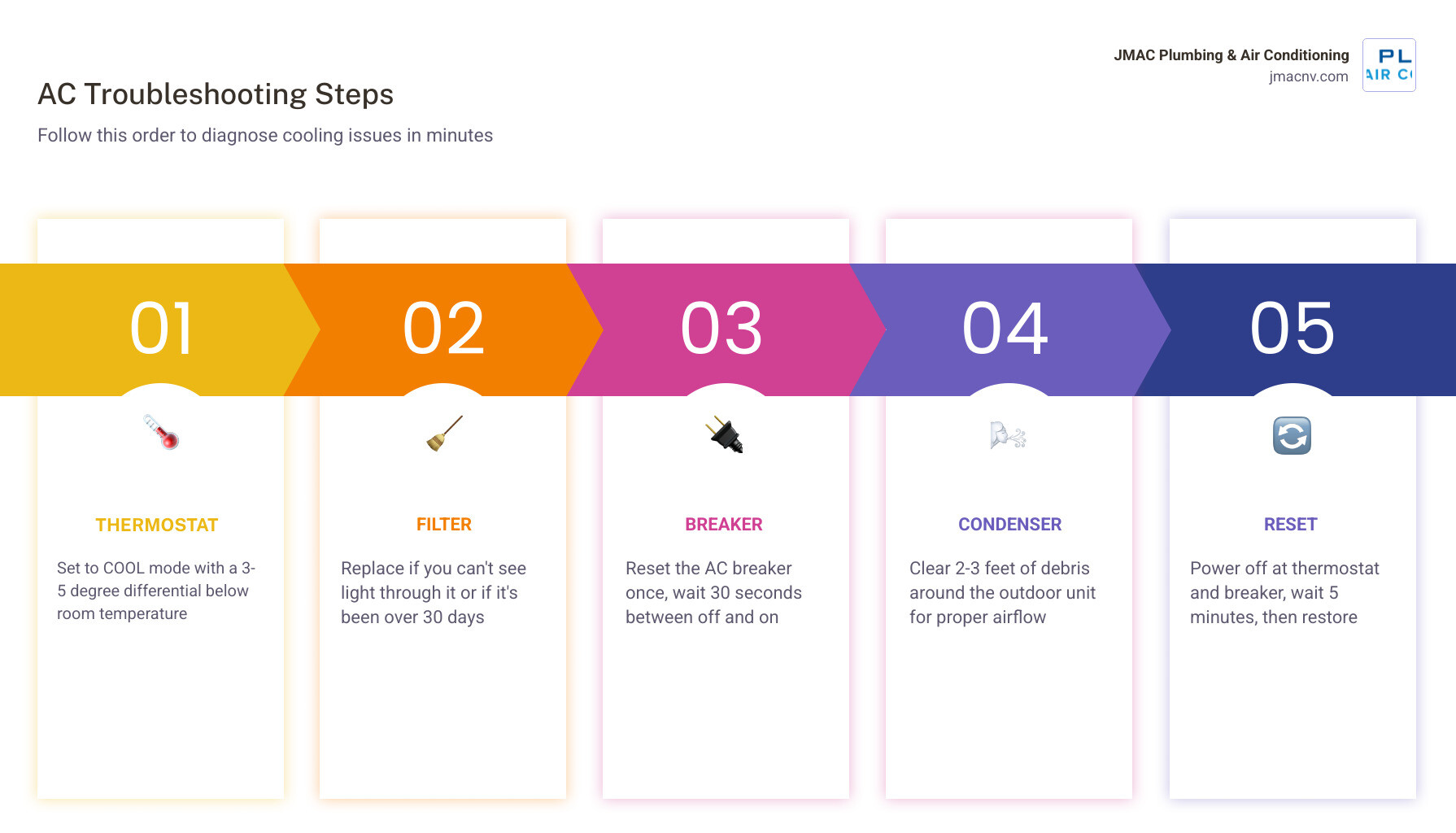
Essential AC Troubleshooting Tips Before Calling a Pro

When your air conditioner struggles to keep up with the intense desert heat in June 2026, it is easy to assume the worst. However, understanding How an Air Conditioner Works can help you realize that many performance issues stem from basic physical restrictions rather than catastrophic mechanical failures.
To systematically diagnose your unit, we recommend starting with airflow and power. These two categories account for the vast majority of summer service calls. In fact, about 30% of the energy in ducted HVAC systems is lost due to duct leaks or poor layout, and when you combine that with restricted airflow from a neglected filter, your system quickly reaches its breaking point.
Before diving into complex diagnostics, you must first Know Your AC System. A standard split system consists of an indoor air handler (usually located in a closet, garage, or attic) and an outdoor condenser unit. Both must have unrestricted airflow and steady electrical power to function. By running through a basic maintenance checklist, you can rule out the easy fixes. For a deeper look at common symptoms, you can read about Common AC Problems and Solutions to help pinpoint the exact nature of your system's struggle.
Thermostat AC Troubleshooting Tips Before Calling a Pro
Your thermostat is the brain of your HVAC system. If it is misconfigured, has dead batteries, or is experiencing a temporary glitch, your entire system will refuse to cool.
To troubleshoot your thermostat, follow these steps:
- Verify the Mode: Ensure the thermostat is set to COOL and the fan is set to AUTO (setting the fan to "ON" keeps the blower running continuously, even when the system isn't actively cooling, which can blow warm air back into your home).
- Check the Temperature Differential: Set the target temperature at least 3 to 5 degrees below the current indoor room temperature.
- Inspect the Batteries: If your thermostat screen is blank, dim, or flashing a low-battery indicator, replace the batteries immediately. Many modern thermostats will shut down the cooling signal as a safety precaution when the batteries run low.
- Assess Thermostat Placement: Ensure your thermostat is not exposed to direct sunlight, drafty hallways, or heat-producing appliances (like lamps or ovens). If a thermostat is tricked into thinking the room is warmer or cooler than it actually is, it will short-cycle or run continuously.
If your thermostat settings are correct but you are still getting warm air from your registers, check out our guide on Why is My AC Blowing Hot Air to identify the next logical diagnostic steps.
Inspecting and Replacing a Clogged Air Filter
A dirty air filter is the single most common cause of HVAC issues. When a filter is clogged with dust, pet dander, and pollen, it starves the indoor blower motor of air. This lack of airflow causes the temperature of your indoor evaporator coil to drop below freezing, leading to a layer of ice that completely blocks your system.
To inspect and replace your filter safely:
- Turn off your AC system at the thermostat.
- Locate your filter slot (typically found in the return air grille on your wall/ceiling or inside the indoor air handler cabinet).
- Slide the filter out and hold it up to a light source. If light cannot pass through the filter, it is completely clogged and must be replaced.
- Install a new filter, ensuring the arrow on the frame points in the direction of the airflow (toward the unit).
For residential systems in the dusty Southern Nevada desert, we recommend using filters rated between MERV 8 and MERV 11. While MERV 13+ filters block smaller particles, they can severely restrict airflow in older residential systems, mimicking the exact problems of a dirty filter. Learn more about how restricted airflow can damage your compressor by reading about The Problem with Clogged Air Filters.
Checking the Circuit Breaker and Power Switches
Air conditioning systems draw a significant amount of electricity, especially during peak summer afternoons in Henderson or North Las Vegas. If there is a power surge or the system overheats, a safety switch may trip to prevent electrical damage.
To safely check for power issues:
- Inspect the Main Electrical Panel: Locate your home's circuit breaker panel. Look for breakers labeled "AC," "Air Handler," or "HVAC." A tripped breaker will usually sit in the middle position between ON and OFF.
- Reset the Breaker Safely: To reset a tripped breaker, flip it completely to the OFF position first, wait 30 seconds, and then flip it back to ON.
- Check the Outdoor Disconnect Box: Near your outdoor condenser unit, you will find a small metal disconnect box mounted on the wall. Open the cover and verify that the pull-out switch or breaker inside is firmly in the "ON" position.
- Locate the Indoor Power Switch: Most indoor air handlers have a simple light-switch-style power switch located nearby in the closet or attic. Ensure this switch has not been accidentally flipped off during storage rearrangements.
Safety Warning: If a circuit breaker trips again immediately after you reset it, do not reset it a second time. This indicates a severe electrical short, a failing capacitor, or a locked compressor motor. Repeatedly resetting a tripping breaker can cause electrical fires or permanent equipment damage.
Clearing Debris Around the Outdoor Condenser Unit
Your outdoor condenser unit is responsible for releasing the heat collected from inside your home. If the outdoor coils are coated in dirt or surrounded by debris, the heat cannot escape, forcing your compressor to work twice as hard and eventually overheat.
To maintain your outdoor unit:
- Maintain a Clearance Zone: Ensure there is at least 2 to 3 feet of clear space around the entire perimeter of the outdoor unit, and at least 5 feet of clearance above it. Trim back any bushes, weeds, or overhanging tree branches.
- Gently Clean the Coils: Turn off the power to the AC at the breaker. Use a standard garden hose with a gentle spray nozzle to rinse away accumulated dust, grass clippings, and desert sand from the metal fins.
- Avoid High Pressure: Never use a pressure washer on your condenser unit. The high-pressure stream will instantly bend the delicate aluminum fins, permanently restricting airflow and requiring professional comb-straightening.
Unclogging the Condensate Drain Line and Float Switch
As your AC cools your home, it removes moisture from the air. This moisture condenses on the indoor coil and drips into a drain pan, where it flows outside through a PVC pipe. Over time, algae and dust can form a thick clog inside this pipe.
When the line clogs, water backs up into the drain pan. Modern systems are equipped with a safety float switch that detects standing water and immediately cuts power to the AC to prevent water damage to your ceilings and floors.
To clear a clogged drain line:
- Locate the Drain Line: Find the white PVC pipe exiting your home (usually near the outdoor unit) or check the drain pan under your indoor air handler.
- Use a Wet/Dry Vacuum: Connect a shop vac to the end of the outdoor drain line. Wrap a rag around the connection to create a tight seal, and run the vacuum for 1 to 2 minutes to suck out the algae clog and standing water.
- Flush with Vinegar: If the line is clear but you want to prevent future clogs, locate the T-shaped access port on the PVC line near your indoor unit. Pour a cup of distilled white vinegar down the line to kill any lingering biological growth. Repeat this monthly during the cooling season.
Verifying Airflow and Clearing Blocked Vents
Sometimes, an AC system is working perfectly, but the distribution of air is restricted. Closed or blocked vents disrupt the pressure balance within your ductwork, which can damage your blower motor over time.
- Inspect All Supply Registers: Walk through your home and verify that all supply vents (the grilles that blow cold air) are open and pointing toward the center of the room.
- Keep Return Grilles Clear: Your system needs to "breathe in" as much air as it blows out. Ensure large return air grilles on your walls or ceilings are not blocked by tall furniture, curtains, or hanging artwork.
- Avoid Closing Vents in Unused Rooms: A common myth is that closing vents in empty rooms saves energy. In reality, closing more than 10% of your home's vents increases duct pressure, leading to air leaks and reduced system efficiency.
System Reset AC Troubleshooting Tips Before Calling a Pro
Just like a computer, modern digital AC control boards can occasionally lock up or experience temporary communication glitches. A simple system reset can clear these errors and allow the system to recalibrate.
To perform a safe hard reset:
- Turn your thermostat completely to the OFF position.
- Go to your main electrical panel and flip both the indoor and outdoor AC breakers to OFF.
- Leave the power off for at least 5 minutes. This allows the internal capacitors to drain completely and gives the refrigerant pressures inside the closed system time to equalize (the "five-minute rule").
- Flip the breakers back to ON.
- Return to your thermostat, set it to COOL, and lower the temperature.
- Be Patient: Most modern systems have a built-in compressor delay that takes 3 to 5 minutes to start blowing cold air. This delay is normal and protects the compressor from damage caused by rapid power cycling.
Recognizing Warning Signs That Require Professional Intervention
While basic maintenance and power resets are safe for homeowners to perform, there is a clear line where DIY troubleshooting must stop for your own safety and the longevity of your equipment. Attempting advanced repairs without proper certifications and tools can turn a minor issue into an incredibly expensive replacement.
If you observe any of the following warning signs, turn off your system immediately and call a licensed technician:
- Frozen Refrigerant Lines or Coils: If you see ice forming on the copper lines leading to your outdoor unit or notice a block of ice on your indoor evaporator coil, turn the system off immediately but switch the fan setting to ON to allow it to thaw. Ice is usually caused by a severe airflow restriction or a refrigerant leak. Under federal law, only EPA Section 608 certified technicians are permitted to handle, test, or recharge refrigerant. Do not attempt to add refrigerant yourself. For more details, read about Why is My Air Conditioner Freezing Up.
- Unusual or Loud Noises: A healthy system should run with a steady hum. If you hear metal-on-metal screeching, grinding, loud banging, or dry rattling, a motor bearing is likely failing or a blower wheel has come loose. Turn the system off to prevent catastrophic structural damage.
- Electrical Burning Smells: If you smell burning plastic, ozone, or hot electrical wiring, shut off the power at the main breaker box immediately. This indicates overheating wires, a failing capacitor, or a burned-out motor winding that poses a direct fire hazard. Learn more about the critical indicators of component breakdown in our guide on the Top Causes of Air Conditioning Failure.
- Frequent Short-Cycling: If your system turns on and off every few minutes without cooling the home, it could be a failing control board, an oversized system, or a safety sensor shutting the system down. Continued operation under these conditions will quickly destroy your compressor.
If your DIY efforts haven't resolved the issue, or if you've encountered any of these dangerous warning signs, we recommend scheduling a professional diagnostic visit. You can read about what to expect during a professional inspection on our AC Inspection Testing Las Vegas NV service page.
Frequently Asked Questions About AC Troubleshooting
Why is my AC running but the house isn't getting cooler?
If your system is running continuously but your indoor temperatures continue to rise, the most common culprits are dirty coils, a clogged air filter, or low refrigerant levels. Start by checking your air filter and cleaning your outdoor condenser unit.
You can also measure the "temperature split" to check system health. Use a digital thermometer to measure the air temperature entering your return grille and compare it to the cold air coming out of your supply vents. A healthy, properly functioning air conditioner should produce a temperature difference (delta-T) of 15 to 20 degrees Fahrenheit. If your temperature split is less than 12 degrees, your system is not cooling efficiently and requires professional attention. For prompt assistance, you can visit our AC Repair Service Las Vegas NV page to schedule a diagnostic visit.
How often should I replace my air filter in 2026?
In our dry, dusty Southern Nevada desert climate, standard manufacturer recommendations (which often suggest replacing filters every 90 days) simply do not apply. Dust storms, desert winds, and local pollen can clog a filter much faster than in other regions.
We recommend checking your filter every 30 days during the peak summer cooling season. If you have pets, suffer from allergies, or live near active construction zones in areas like Summerlin or Henderson, you should replace your 1-inch filters every 30 to 60 days to ensure your system maintains maximum airflow and efficiency.
What should I do if my AC breaker keeps tripping?
If your AC breaker trips, you should only reset it once. A tripped breaker is a safety response to an electrical overload. If it trips again immediately after being reset, it means a critical component — such as the start capacitor, the outdoor fan motor, or the compressor itself — is drawing too much electrical current. Continuing to reset the breaker can destroy your compressor or cause electrical fires. Keep the breaker off and contact a licensed HVAC technician to inspect the electrical system.
Conclusion
Taking ten minutes to run through basic AC troubleshooting steps can save you from a hot afternoon of frustration and help you avoid unnecessary service calls. By checking your thermostat settings, replacing your air filter regularly, and keeping your outdoor unit clean, you can resolve the most common cooling issues yourself.
However, when DIY fixes aren't enough, you need a team you can rely on. JMAC Plumbing & Air Conditioning is a family-owned and operated local business that has served Las Vegas, Henderson, North Las Vegas, and the greater Southern Nevada region for over 30 years. Our licensed, highly trained technicians do not work on commission, meaning you will always receive honest, transparent service without high-pressure sales tactics.
To prevent unexpected mid-summer breakdowns and keep your system running at peak efficiency all year long, consider scheduling an annual professional tune-up. Contact us today to book your AC Maintenance Tune Up and ensure your home stays comfortable, no matter how high the desert temperatures climb!
Need Help?
Contact us today to discuss your needs. Our team is ready to help.
About the Author
JMAC Plumbing and Air Conditioning
More Articles
View All PostsRelated Articles


Ready to Get Started?
Whether you need a repair, maintenance, or a new installation, our expert team is here to help.